
Mummification Workshop
Primary and Secondary (ESO)
From September to June, Monday to Friday.
Workshop activity.
Minimum group size to carry out the activity: 10 students. Maximum group size: 30 students.
Two workshops can be held simultaneously.
Activity languages:
Catalan - Spanish - English
Price: €6.50 per student (accompanying adults free, up to a maximum of 3 per group).
Price for activity in English: €7.80 per student
Duration: 1 h
You can book online, by calling 93 488 01 88 or by sending an email to visites@museuegipci.com
Why did the ancient Egyptians mummify people?
Have you ever wondered why the ancient Egyptians practiced mummification? Who could access this ritual? What secrets did the mummification process hide? And what had to be done to achieve eternal life?
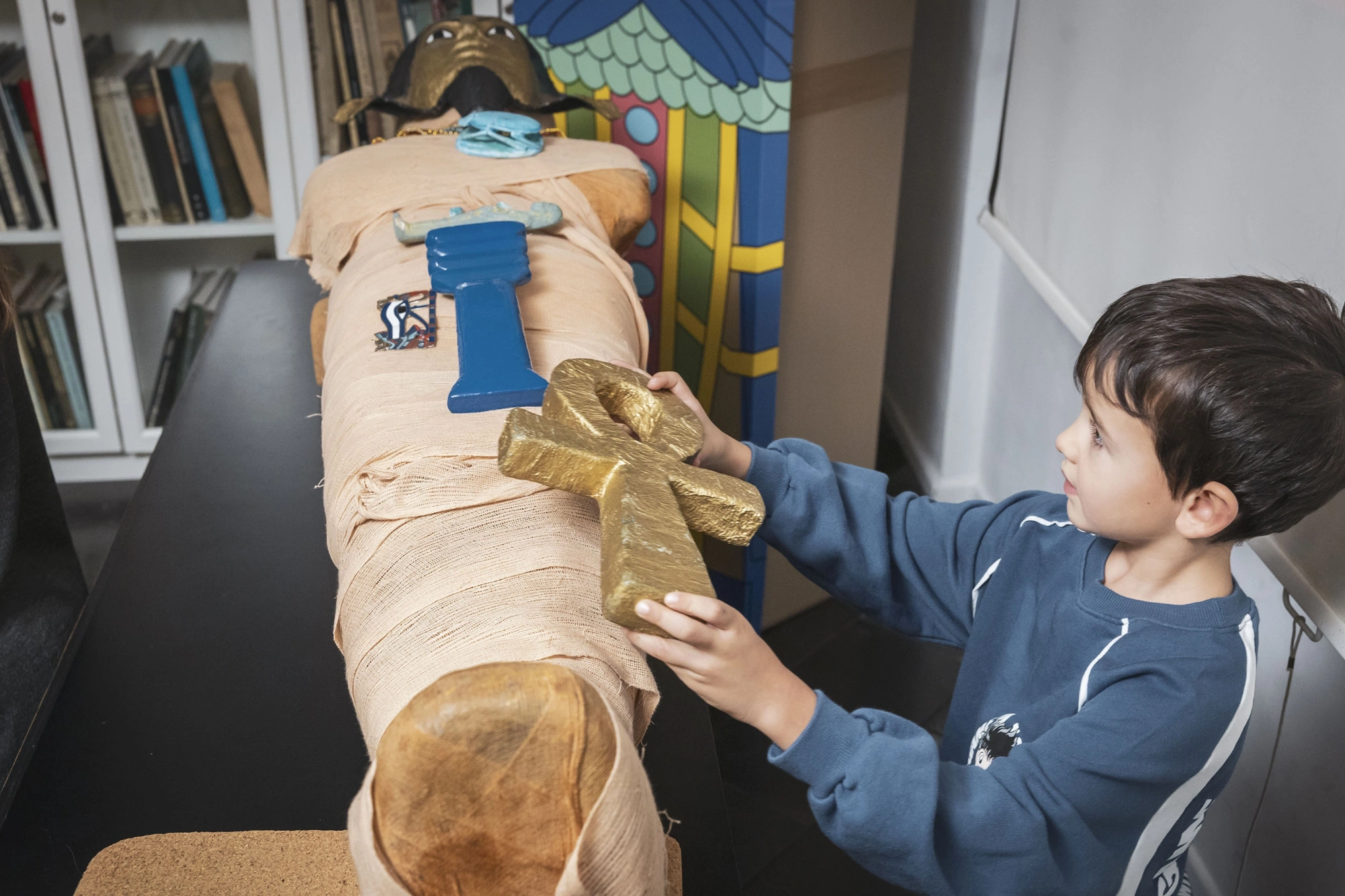
In this workshop you will discover how the ancient Egyptians prepared the body and the ritual for the great journey to the Afterlife. We will talk about tombs, amulets, hieroglyphs, deities and beliefs, answering these fascinating questions. To finish, we will stage an authentic mummification process that will allow us, step by step, to understand how a body was transformed, prepared and taken along this magical path to eternity.
An immersive, educational and surprising experience that will connect you experientially with one of the most fascinating civilizations in history.
Curriculum information
Objectives
Understand the importance of beliefs and funerary rituals in Ancient Egypt.
Experience an immersive and hands-on activity about the mummification process.
Explore the concept of eternal life and ancient Egyptian views on death.
Encourage interest in ancient civilizations and historical heritage.
Teaching Methodology and Educational Resources
Dynamic and participatory presentation.
Open dialogue and Q&A session.
Visualization and handling of objects and replicas.
Final staging to promote experiential learning.
Competences (ESD)
Critical and historical thinking
Intercultural knowledge
Respect for the diversity of beliefs and cultures.
Appreciation of cultural and historical heritage.
Cooperative work to solve challenges
Key Competencies
Anticipation competency
Strategic competency
Collaboration competency
Systemic and critical thinking competency
Self-awareness competency
Integrated problem-solving competency
SDGs addressed
SDG 4: Quality Education (cultural and historical knowledge).
SDG 11: Sustainable Cities and Communities (preservation of heritage).
SDG 16: Peace, Justice and Strong Institutions (respect for cultural diversity).
Areas of knowledge by level
Primary
Knowledge of the social and cultural environment
- Ancient civilizations
- Culture, beliefs and life in Ancient Egypt
- History and chronology (passage of time)
Education in values and citizenship
- Respect for other cultures and beliefs
- Diversity and cultural heritage
Art education
- Interpretation and observation of symbolic objects
- Expression through dramatization
Catalan/Spanish language
- Oral comprehension and communication
- Expression and participation in dialogic exchanges
Secondary
Social sciences, geography and history
- Ancient History: Egypt
- Culture, religion and society in ancient civilizations
- Historical sources and archaeology
Ethics and citizenship education
- Reflection on concepts such as death, the Afterlife and cultural diversity
- Intercultural dialogue
Visual and plastic arts education
- Interpretation and analysis of symbolic objects